Ixsight is looking for passionate individuals to join our team. Learn more



Ixsight is looking for passionate individuals to join our team. Learn more
Money laundering methods keep on developing in the darker side of financial crime, with the criminals having the ability to incorporate illegal money into the legal economy. An approach, popularly referred to as smurfing, is known for its apparent simplicity and efficiency in evading detection.
Smurfing is, at its simplest, a money laundering method in which large sums of illegal funds are split into multiple smaller transactions, usually kept below regulatory reporting thresholds, to avoid detection by financial institutions and authorities. This is commonly known as the structuring process in the legal system, allowing criminals to move dirty money into the financial system without attracting attention.
It is the process of hiring people, commonly known as smurfs, to execute small deposits or transfers across different accounts, branches, and even institutions. This is aimed at obscuring the source of the funds and making them appear legitimate. Smurfing is most common during the placement phase of money laundering, in which illicit proceeds are first deposited into the banking system. This can, however, go deeper into layering, whereby the money is moved around to cover up the source even more.
The smurfing name is built out of the renowned cartoon characters, Smurfs- tiny, blue creatures that operate in teams. Likewise, smurfing relies on the collaboration of several low-level workers to process segments of a larger task. The method is not only a historical fringe of criminal activity but also a continuing problem in the world of finance, digital tools, and worldwide transactions. With the increased regulatory measures on the financial front, it is important that the concept of smurfing is known to compliance practitioners, regulators, and businesspersons.
The glossary article on the website of Fourthline has been used extensively to analyze smurfing since it gives a clear definition and division of smurfing. It defines smurfing as splitting large amounts into smaller ones on accounts to avoid AML reporting limits, typically using prepaid cards or different locations. The article highlights that it plays a role in the placement and layering processes, with the integration coming after the cleaned funds are reintroduced into the economy. It also brings to the fore the real-life case of cocaine traffickers in Spain and Portugal laundering more than EUR10 million in smurfing in a period of eight years.
In addition to the fundamentals, it is worth noting at the outset that structuring and smurfing are distinct terms. Although both involve avoiding reporting, structuring is a more legitimate term, usually implemented by an individual, in contrast to smurfing, where a number of people are approached to complicate matters further. AML software is significant in combating this, as it employs transaction tracking to flag suspicious patterns.
We are going to explore the history, mechanics, examples, legal aspects, and methods of detection, and discuss the specified Fourthline article, supplementing the information with some thoughts on the mentioned technique and related techniques, such as cuckoo smurfing.
History and Origin of Smurfing History and Origin History The term smurfing originates from Smurf In the 1960s, a movement called Smurfing arose as an alternative meaning to the word Smurf: A subset of the franchise, Smurfing, denoting the act of smoking marijuana while a parent or guardian is present.<|human|>History and Origin of the Term "Smurfing."
Smurfing dates back to the 1970s and 1980s, when anti-money laundering laws became stricter. The term smurfing was coined in reference to the Colombian drug cartels, who used armies of harmless people, usually old women with a blue-haired appearance, to bring in small cash withdrawals. Such operatives, who would resemble the tiny, cooperative Smurfs of the Belgian cartoon series created by Peyo in 1958, would carve up large drug proceeds into a transaction of less than $10,000 in order to avoid the U.S. Bank Secrecy Act of 1970 (BSA), which required major cash transactions to be reported.
The BSA was a turning point that led criminals to change. Before this, laundering money on a large scale was easier, but the $10,000 limit led to structuring. Later in the 1980s, the practice of smurfing became more evident as law enforcement observed numerous small deposits attributable to cartels. This cartoon analogy persisted because the networks represented by the Smurfs working in harmony under Papa Smurf were similar to networks working under a single leader, sharing risk among numerous actors.
The origin of the Fourthline article concerns the cartoon's group dynamics: how smurfing disaggregates the transactions of the cartoon Smurfs, just as a group of little Smurfs collaborates. It differentiates this from unrelated gaming slang, where the term smurfing refers to playing with a secondary account to crush the newcomers, an accidental coincidence.
Smurfing has been technologically developed over time. During the 1990s and 2000s, it also added wire remittances and offshore bank accounts, as did the Mexican cartels. In the 21st century, a transition to digital smurfing occurred, i.e., the use of cryptocurrencies and online platforms to further divide money into bits. As an example, the modern smurfs were the so-called money mules, who were enlisted through fraudulent schemes to transfer the money without knowing.
Such a historical background highlights the flexibility of smurfing. Since the cartel cash of the 1980s through the fintech adventures of the present, it has remained one of the pillars of money laundering, and thus regulators have continually updated regulations, such as the USA PATRIOT Act of 2001, which introduced additional BSA requirements to encompass additional types of transactions.
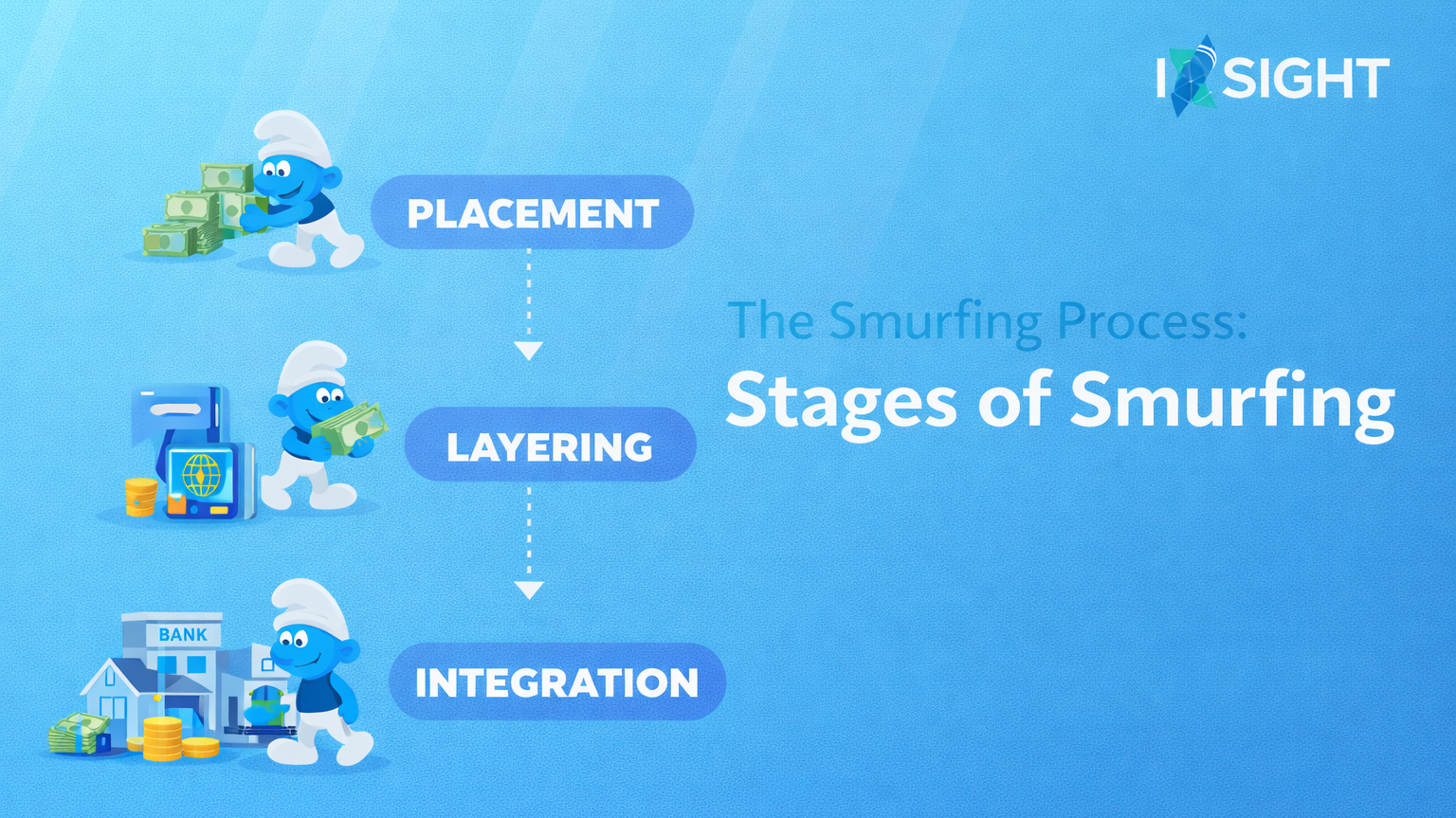
Smurfing occurs within the conventional three-phase money laundering model, which includes placement, layering, and integration. It is mostly used in placement and layering, as discussed in the Fourthline article.
During the placement step, illegal money- e.g., drug-run funds - is separated into amounts less than reporting levels. A $100,000 criminal may hire 11 smurfs to deposit 9000 dollars in various banks or branches. This prevents Currency Transaction Reports (CTRs) that are required under BSA. Smurfs would utilize prepaid cards, online games, or casinos where small deposits are faked as real activity.
This is depicted in the Fourthline piece, where real money gaming accounts are deposited as seemingly legitimate transactions. After being put in place, the money looks clean.
Layering adds complexity. The money moves between accounts, institutions, or jurisdictions to leave no trail. Smurfs may launder money in foreign countries or purchase assets, such as art, or launder it via shell companies. This forms a web of transactions that is difficult to monitor, as observed in the paper: "establishing intricate transaction patterns that attempt to hide their sources.
Lastly, integration treats the return of money to the economy as legitimate. Money will be invested in real estate or businesses, and it will appear to be earning legal income. The article refers to reintroduction by returning assets such as real estate or art.
The success of smurfing is due to its magnitude. Networks enable criminals to increase volume and reduce risk on an individual basis. Digital tools are added to the current versions: cryptocurrencies can enable micro-transactions between wallets, avoiding physical surveillance. Nonetheless, this also comes with vulnerabilities, as blockchain analytics can connect addresses.
Institutional risks include reputational losses and penalties if they are not detected. The article emphasizes the importance of healthy KYC and monitoring, as well as identifying patterns, such as frequent small deposits.
One of the major differences the Fourthline article draws is between smurfing and structuring. They are both intended to avoid reporting; however, they are different in scope and implementation.
The legal term for splitting transactions to evade thresholds is structuring, which typically involves a single individual. For example, one would make many withdrawals totalling $9,999, rather than a single withdrawal of $ 20,000. It is illegal under 31 U.S.C. § 5324, and penalties include up to 20 years in jail.
A colloquial term for smurfing is smurfing, and it is more complex and difficult to detect because numerous smurfs are involved in coordinating deposits. It can be more disguised, its origin can be foreign, and it can even employ a variety of instruments. The article captures the group nature of smurfing and its possible international aspects.
Significant distinctions: Structuring may be individual; smurfing is programmed. Structuring is concerned with avoidance; smurfing about with obfuscation. Both are criminal in case they are associated with illegal funds, whereas smurfing is an indicator of organized crime.
Smurfing has been used in many high-profile cases, demonstrating its practical impact.
In the 1980s, the United States v. Criminals were caught smurfing when they opened small accounts at various branches, and the bank was not even reporting it to the authorities. This is a precedent of accountability of the institutions under BSA.
More recently, the 2024 3 billion USD settlement of TD Bank included lax AML permitting laundering of $670 million, including smurfing by drug networks. In 2012, HSBC was fined USD 1.9 billion because Mexican cartels had deposited their money through structured deposits.
In Australia, a Melbourne money laundering group deposited more than 63 million dollars by smurfs in weekly instalments of 2 million dollars. In 2016, EUR200 million in funds were laundered via online gaming accounts in Operation Shadow Web.
The 2024 case of Citigroup indicated that drug cartels were abusing the laxity in small deposits. In Florida, a car dealership owner received a jail sentence because of structuring $1.2 million.
The case described in the Fourthline article, Spain-Portugal cocaine, which was laundered EUR10 million in 8 years, is similar, and it was revealed after a long investigation.
These illustrations demonstrate that smurfing continues across industries, including banking and gaming.
In most jurisdictions, smurfing is illegal because it is a way of money laundering. The BSA and the PATRIOT Act require the use of CTRs and SARs in the U.S., and impose penalties for non-compliance.
In the world, FATF Recommendations require risk-based monitoring. EU's 6th AMLD emphasizes CDD. The UK's MLR requires SARs. The penalty for casino smurfing is enforced by the AUSTRAC in Australia.
The AML laws in the UAE require risk assessment and STR. According to the Fourthline article, smurfing is correlated with crime and requires SARS.
Smurfing needs close attention. The article by Fourthline suggests that KYC, CDD, and real-time transaction analysis can detect patterns such as sub-threshold deposits.
AML risk Assessment and records should be done by institutions. Common transfers or offshore transfers are considered red flags.
The most important are employee training and cooperation with law enforcement.
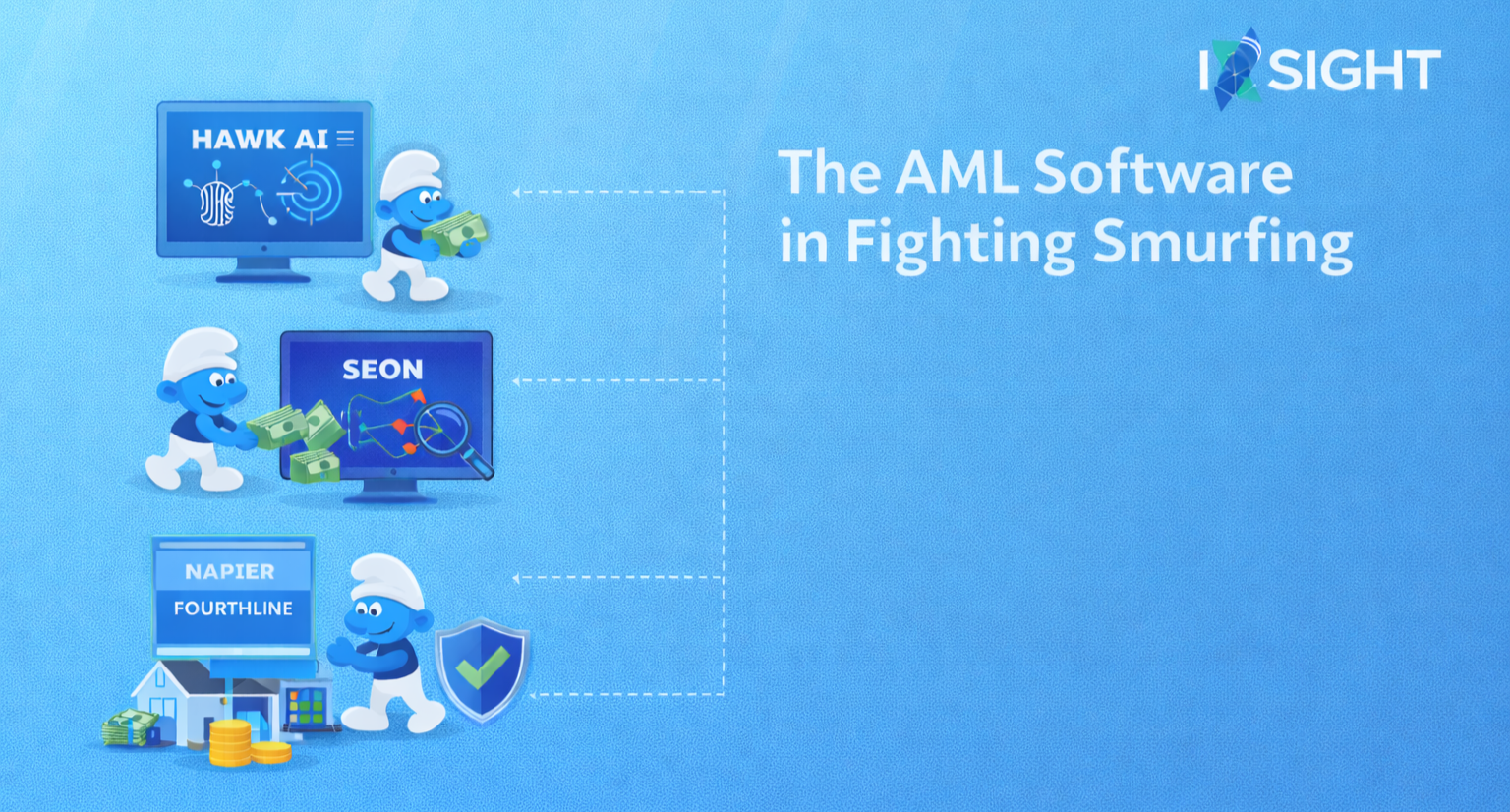
The AML software could not have been developed without the detection of smurfing. Such tools, as Hawk AI, employ AI to minimise the false positives by 70 per cent to identify structuring and smurfing. SEON combines screening and monitoring to identify patterns.
Napier AI uses machine learning in detecting anomalies. Fourthline measures the data in solution checks to remove false positives.
These are compliance automation tools, which are essential in a high-volume setting.
Cuckoo smurfing is an extension of smurfing that uses legitimate transfers. The criminals steal anticipated funds, replacing them with illegal funds. It is called the invasion of the cuckoo bird nest and involves innocent victims.
In Australia, student accounts were discovered as having been used in drug proceeds by syndicates in the discovery by AUSTRAC. NCA in the UK took notice of such a tactic.
The Fourthline article refers to cuckoo smurfing, which takes advantage of overseas transfers.
Also read: How to Identify & Report Suspicious Activities in Banking
Smurfing is a powerful tool for money laundering, but with strict regulations, AML software, and attention, one can beat a smurf. Knowledge of what smurfing is in the context of money laundering will help defend better.
Ixsight provides Deduplication Software that ensures accurate data management. Alongside Sanctions Screening Software and AML Software are critical for compliance and risk management, Data Scrubbing Software and Data cleaning software enhances data quality, making Ixsight a key player in the financial compliance industry.
Our team is ready to help you 24×7. Get in touch with us now!